SHARE Equity: The Abortion Ecosystem Needs More Funding — And Infrastructure First To Make It Go Further
The Challenge
The Unassailable Truth
Every person deserves the freedom to make decisions about their own body, their own future, and their own family.
The right to bodily autonomy is fundamental. It is the foundation upon which education, economic opportunity, health, family stability, and self-determination are built. A society cannot claim to value freedom while denying people the ability to make decisions about their own reproductive lives.
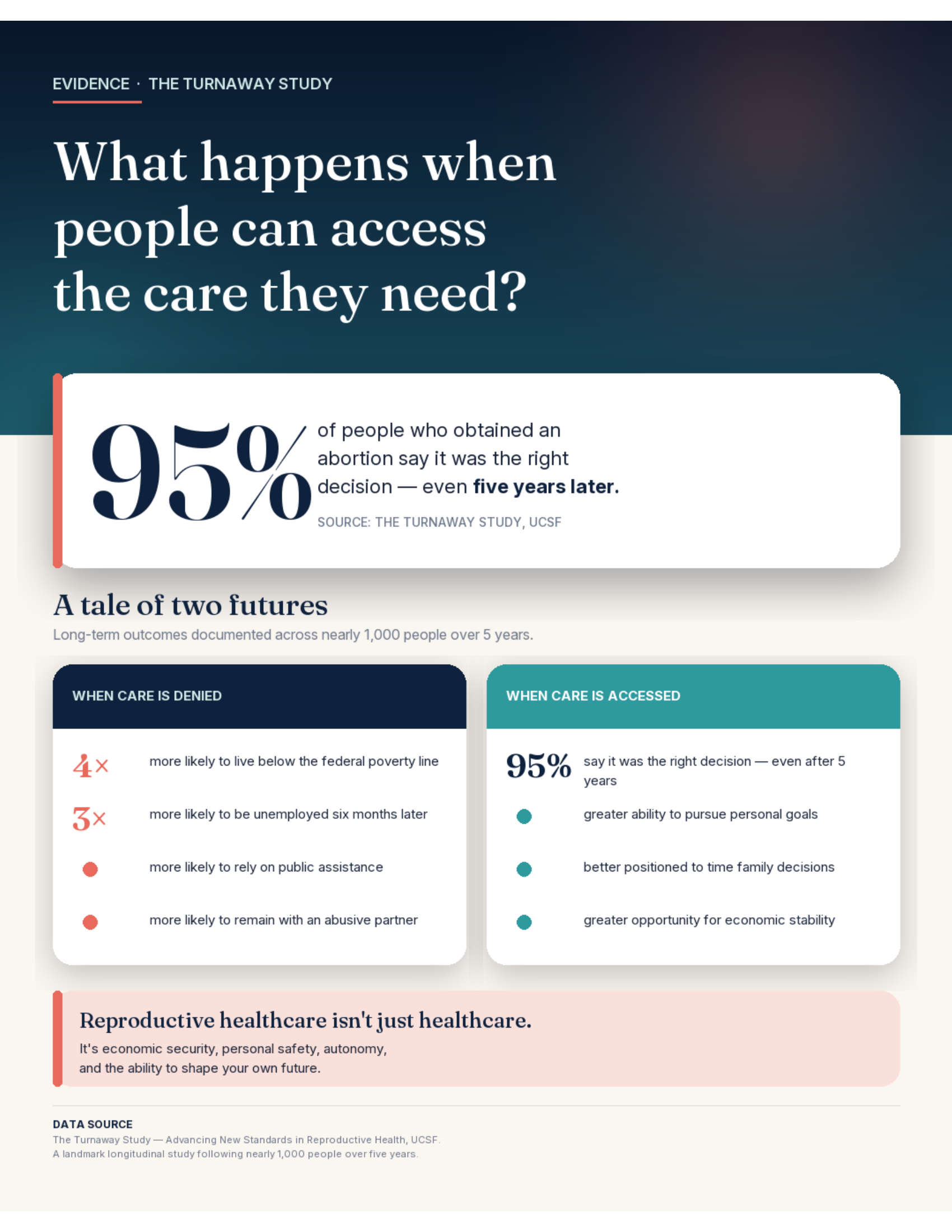
Research has consistently shown that when people are able to obtain the abortion they seek, they are more likely to complete their education, participate in the workforce, avoid poverty, and build the futures they choose. Their existing children experience greater economic security and improved developmental outcomes. Conversely, when people are denied abortion care, they are significantly more likely to experience long-term financial hardship, remain in abusive relationships, suffer adverse health outcomes, and see diminished opportunities for themselves and their families.
Bodily autonomy is therefore not simply a healthcare issue. It is an issue of racial justice, economic justice, gender equity, and human dignity.
A right that exists only on paper is not enough.
A right must also be reachable.
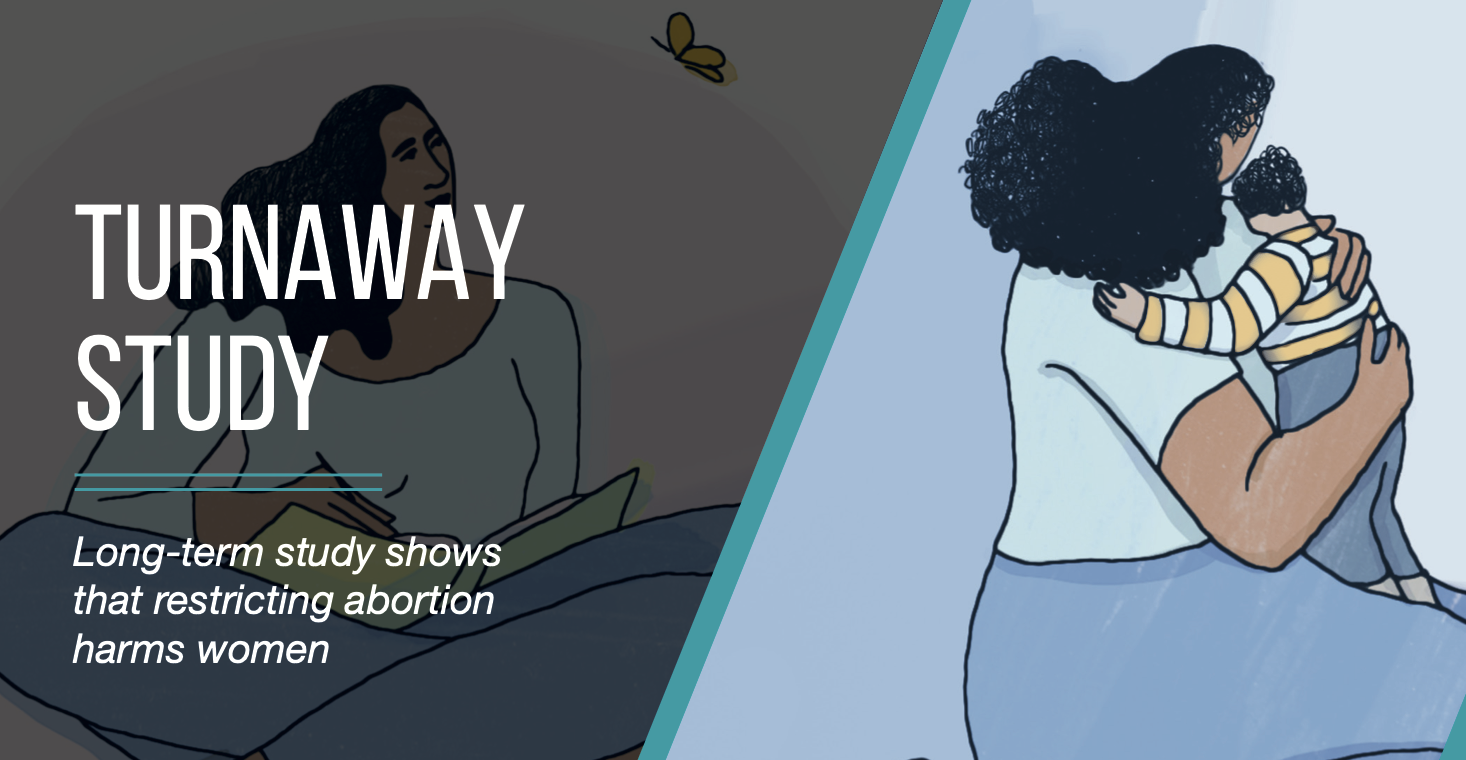
The evidence is clear. The landmark Turnaway Study demonstrates that access to abortion changes the trajectory of a person's life. People who receive the abortion they seek are more likely to maintain economic stability and pursue their educational and career goals.
Planned Parenthood Federation of America and independent clinics across the U.S.
Fifty Years of Feminist Progress. One Coordinated Attack.
For more than 50 years...
Feminists, abortion providers, Black women and families, reproductive justice leaders and organizations, philanthropists and patients worked together to make that freedom real.
They secured constitutional protections. They built clinics where none existed. They created abortion funds to help people who could not afford care. They organized practical support networks that helped patients travel, find lodging, arrange childcare, and navigate increasingly hostile political environments.
Together they created one of the most resilient reproductive healthcare movements in American history.
Their opponents never accepted those victories.
Instead, they pursued a deliberate strategy of dismantling abortion access piece by piece.
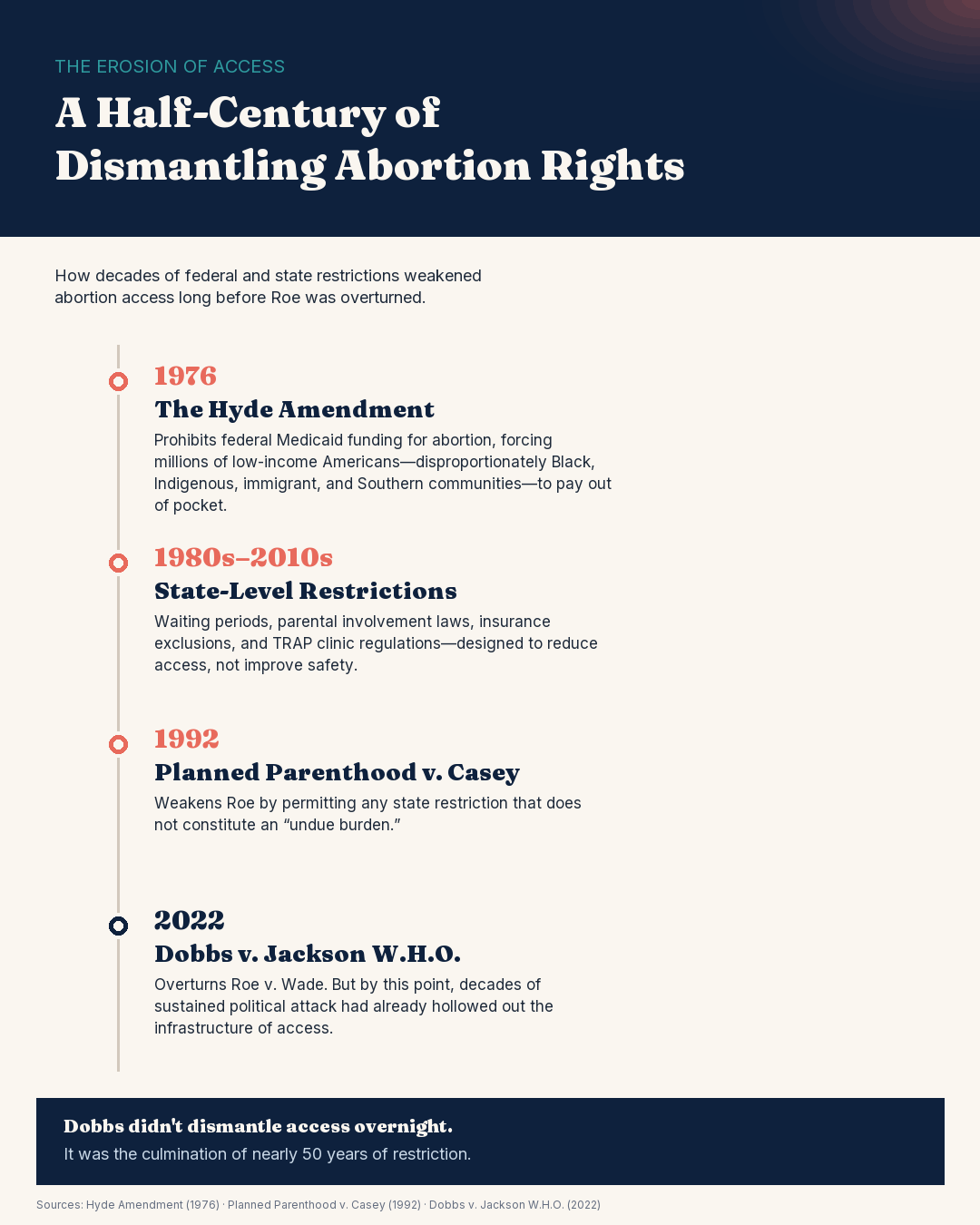
But the opposition never stopped.
For decades, a well-funded movement systematically worked to eliminate abortion access.
They:
- 🚫 Closed clinics through restrictive laws
- 💵 Cut off insurance coverage (Hyde Amendment)
- ⚖️ Criminalized providers
- 😔 Stigmatized patients
- 📉 Starved reproductive healthcare of investment
Long before Roe fell, millions had already lost meaningful access.
Dobbs Didn't Start the Crisis.
It completed a strategy that had been unfolding for half a century.
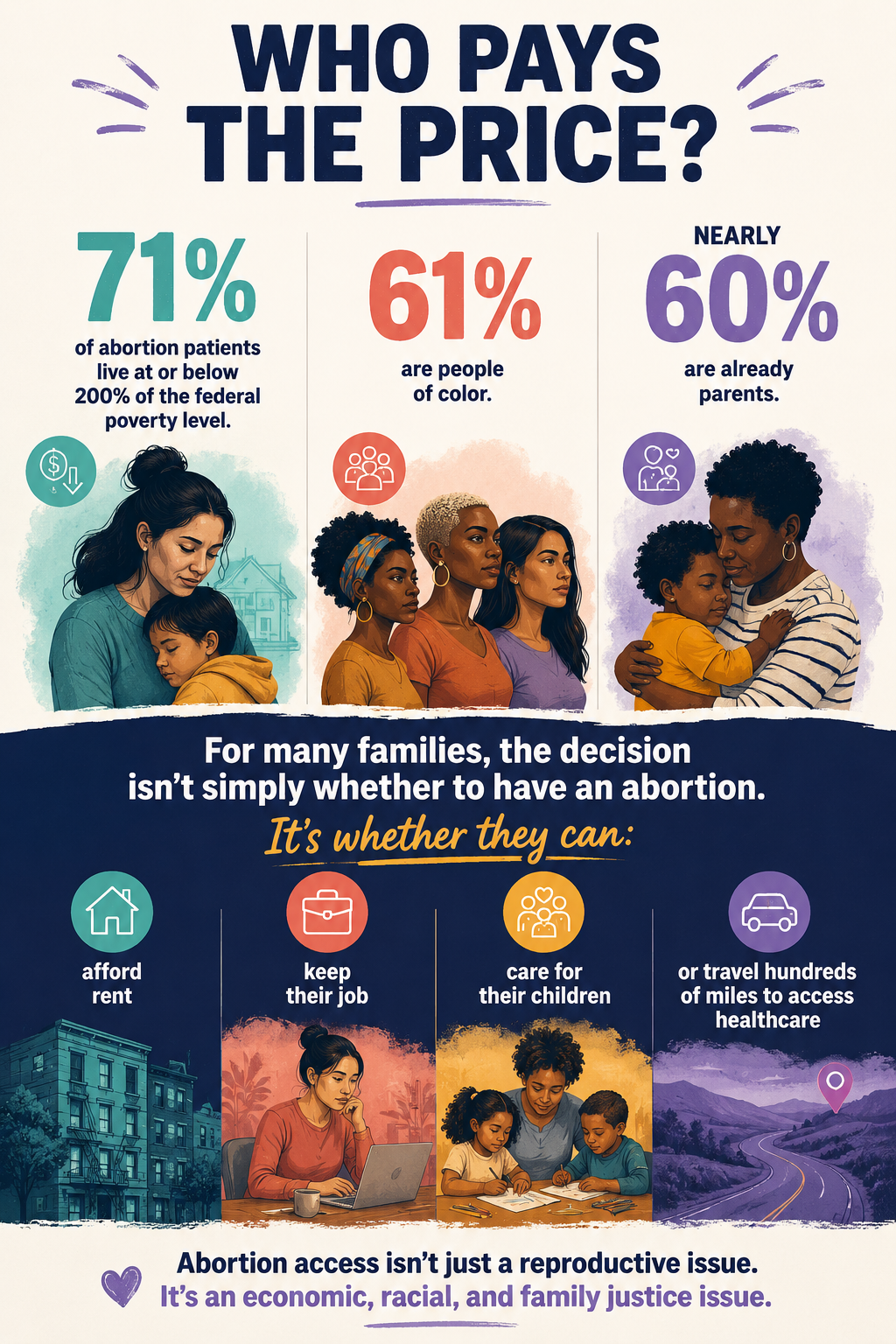
Today, abortion access no longer depends primarily on whether abortion is legal. It depends on whether people can navigate an increasingly fragmented healthcare landscape with fewer providers, greater travel distances, higher costs, and shrinking financial support.
Demand exploded.
Capacity did not.
The Challenge Has Changed.
For decades, the movement fought to secure legal rights.
Today, the challenge is different.
Rights without access are not enough.
The next generation of reproductive freedom depends on building the infrastructure that allows people to actually use those rights—where they exist.
The next chapter isn't just about protecting rights.
It's about building the systems that make those rights real.
When Coordination Depends on Heroics
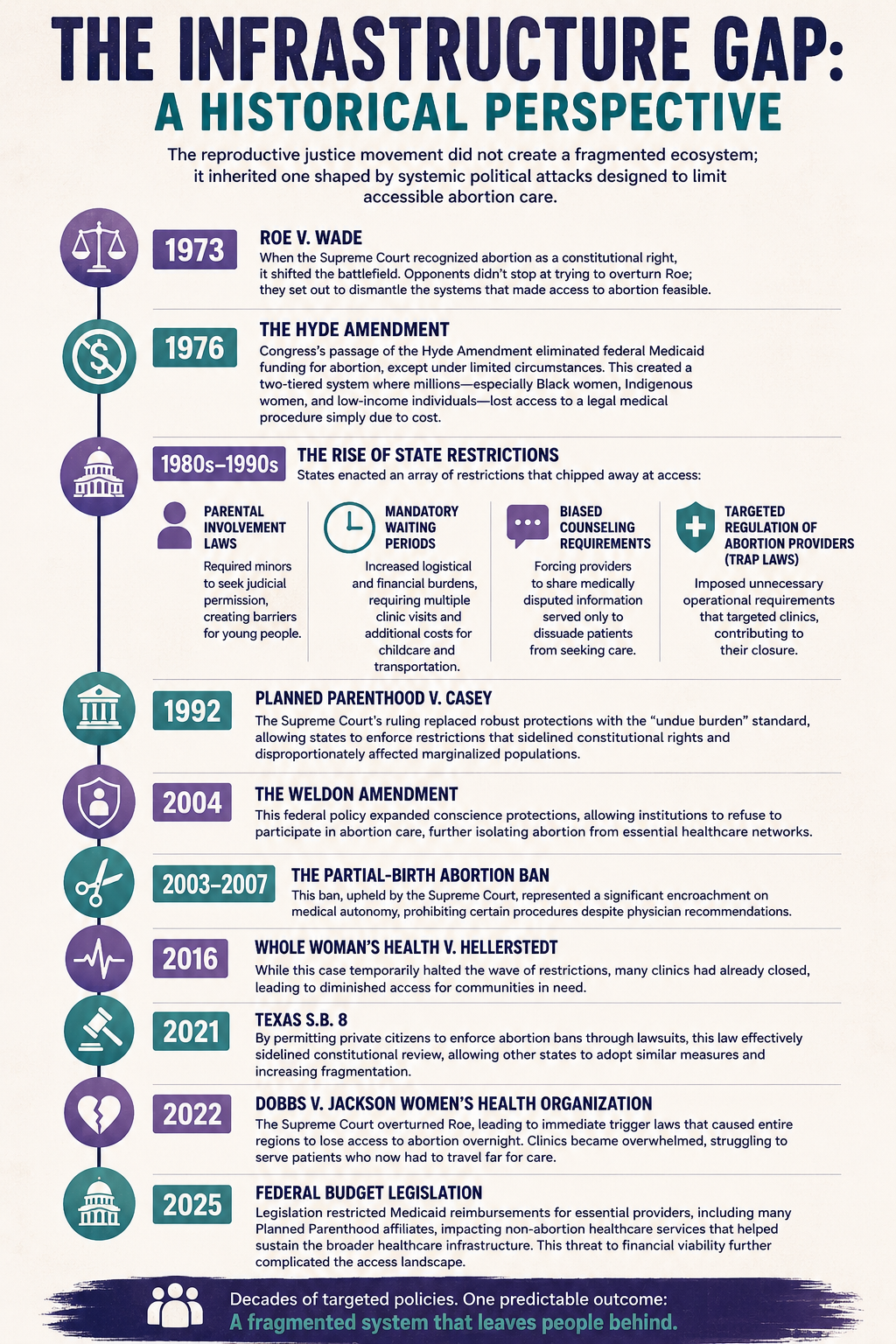
The reproductive justice movement did not build a fragmented ecosystem.
It inherited one.
The Missing Infrastructure
For fifty years, legislators, courts, and political organizations systematically separated abortion from the broader American healthcare system, wielding this disruption as a tool of control primarily over marginalized communities. They denied public funding, restricted insurance coverage, closed clinics, all activities that had disproportionate impacts on Black, Indigenous, and low-income individuals. This dismantling of access not only obstructed healthcare but effectively stripped away the bodily autonomy of those already facing systemic inequalities.
In response, the reproductive justice movement built abortion funds for procedural care, practical support organizations for travel and logistics, legal defense organizations, and community networks — because people's lives depended on it. Each political attack demanded another act of innovation; every restriction necessitated another institution; every clinic closure required yet another workaround — actions driven by a need to serve those most affected by oppression. Despite creating one of the most resilient reproductive health ecosystems in the world, the movement never had the privilege of capacity, nor the mandate, to construct the infrastructure that connects these lifelines.
Instead of investing in interoperable technology, shared financial systems, coordinated patient navigation, and long-term capital, the movement spent five decades defending against the next assault. It built extraordinary organizations under extraordinary pressure, but these efforts were denied sustained investment crucial for infrastructural support.
They invested in survival because survival was always at stake. The movement and its stakeholders rarely had the time, unrestricted capital or political stability to build the shared infrastructure to connect these extraordinary organizations.
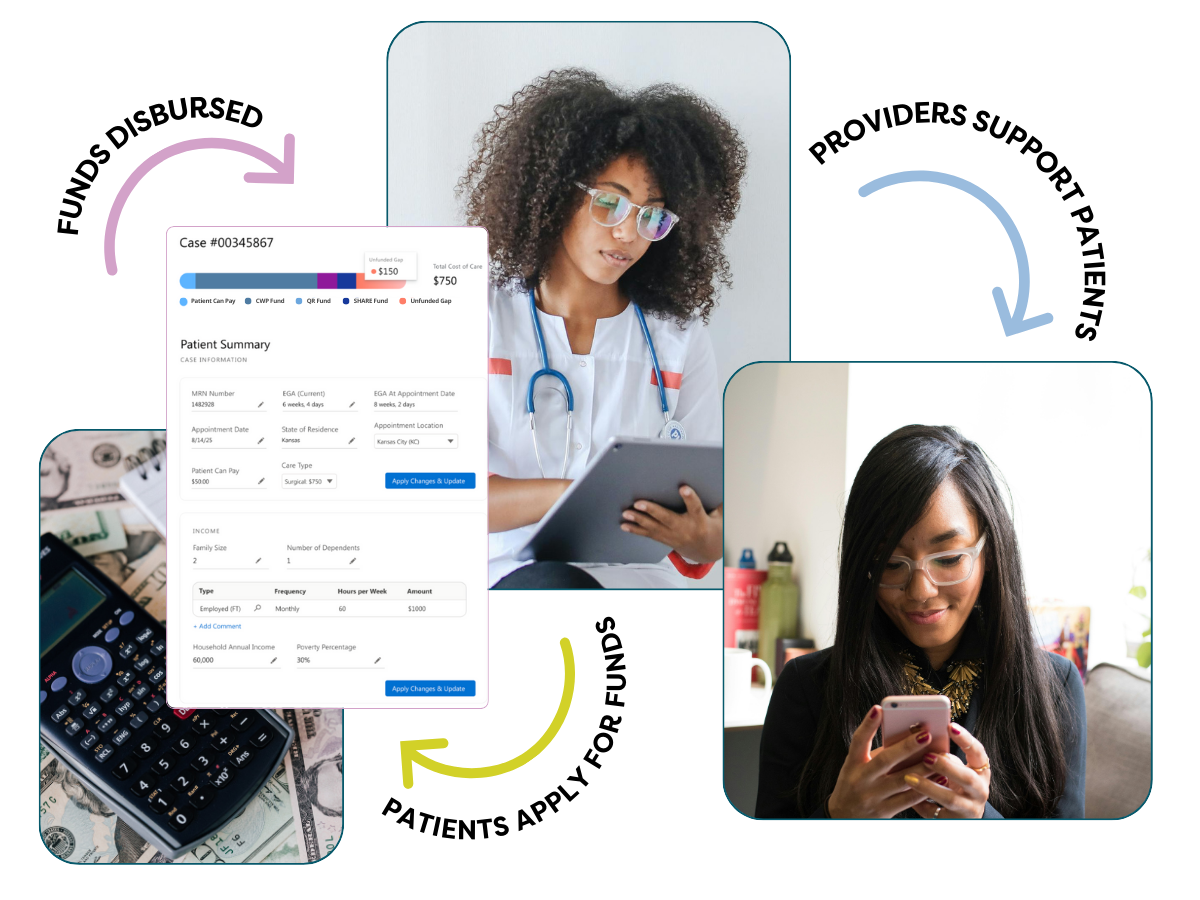
Today patients navigate more than a dozen interactions before even reaching a single appointment.
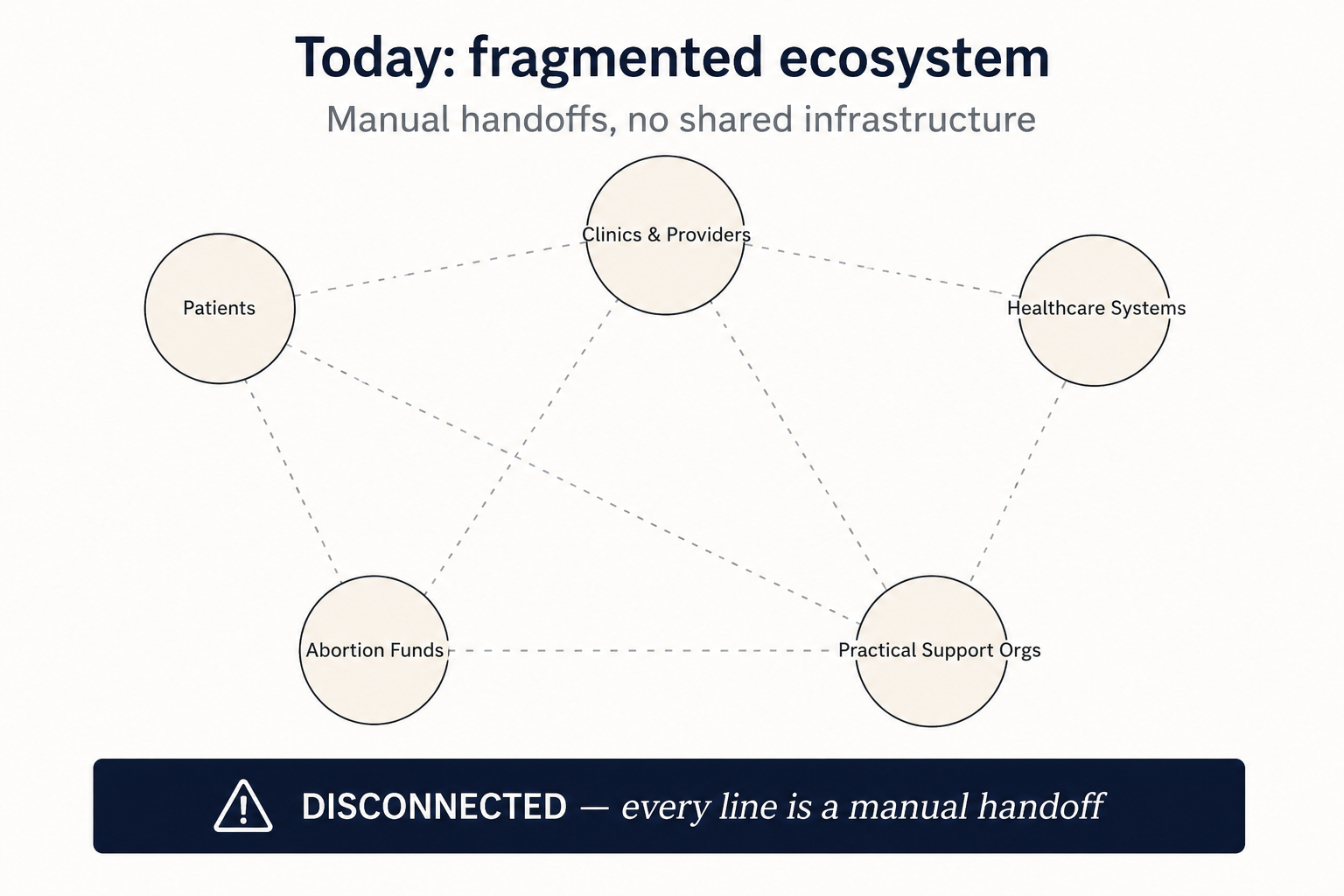
Providers coordinate funding through phone calls, spreadsheets, emails, and disconnected software. Abortion funds cannot easily coordinate with one another. Practical support organizations often lack visibility into provider capacity. Every organization performs extraordinary work. Too often, they perform it without shared operational infrastructure.
Without coordinated systems, bodily autonomy exists only on paper.
Thousands of people are doing the work.
The system still doesn't exist.
This is not a failure of commitment.
It is a failure of coordination.
The Next Generation of Stewardship
The same political movement that attacked abortion rights also attacked abortion financing.
The Hyde Amendment excluded abortion from Medicaid nearly fifty years ago. Commercial insurance remains inconsistent. Many providers cannot justify the administrative cost of participating in payer networks or absorb inadequate reimbursement rates. As a result, philanthropy has been asked to subsidize what should function as part of the healthcare system.
For decades, philanthropy has answered that call. It has sustained clinics, strengthened abortion funds, supported providers, and ensured that people with the fewest financial resources could still obtain essential healthcare.
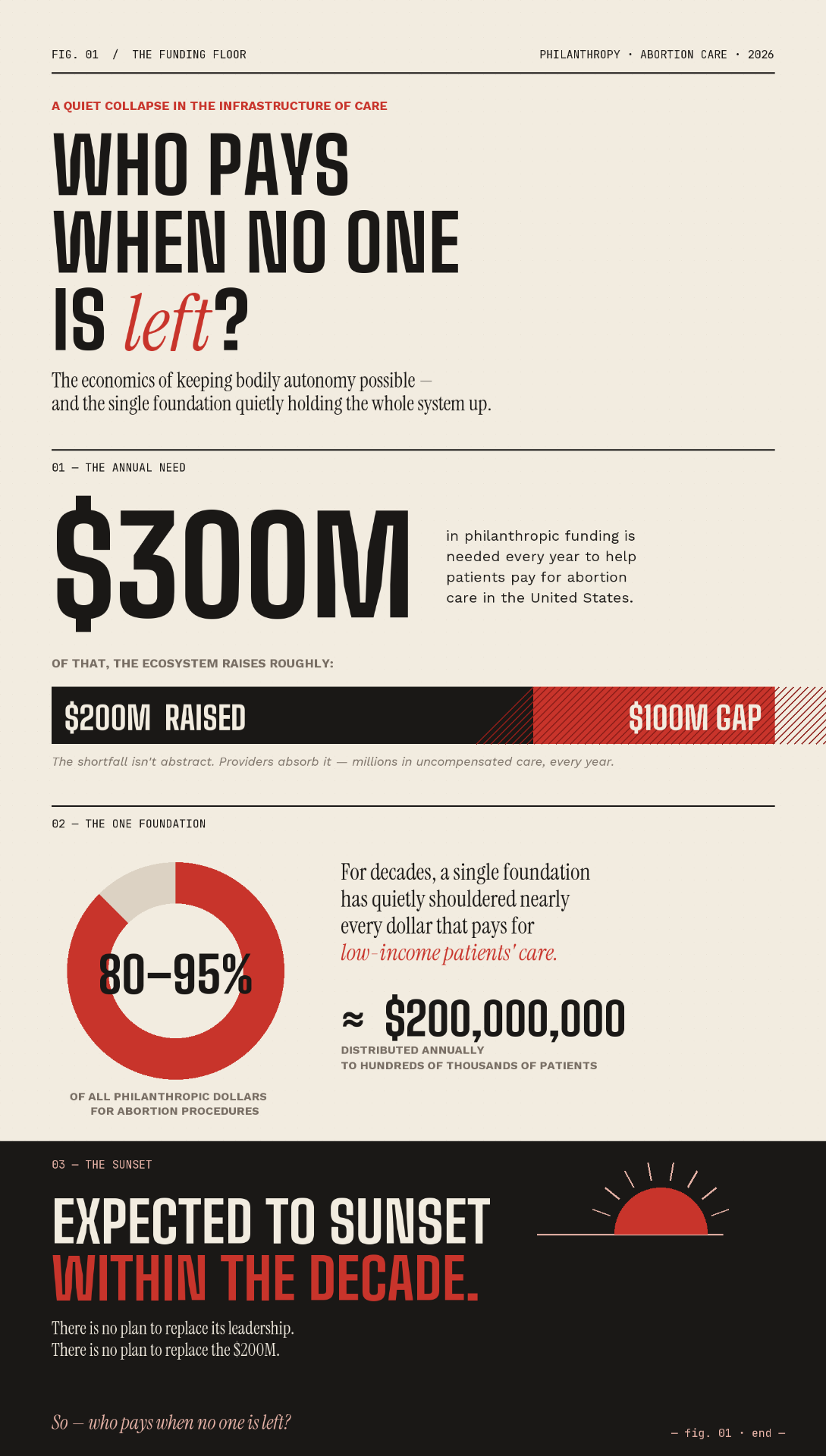
The question is not whether this model succeeded.
It saved lives.
The question is whether the next generation will inherit a movement that depends on one extraordinary act of philanthropy—or one supported by permanent institutions capable of sustaining abortion access for generations to come.
The challenge before us is not simply to replace philanthropic dollars.
It is to redesign the system those dollars have been asked to carry.
The Emerging Opportunity
Building the Gold Standard of Abortion Care
Building What Comes Next
Every generation inherits the responsibility to build the institutions its predecessors could not.
For more than 50 years, the reproductive justice movement built extraordinary institutions that protected abortion access:
- Won legal rights
- Built clinics
- Created abortion funds
- Organized practical support networks
- Sustained care under relentless political attack
Those institutions were built to protect patients—not to function as one coordinated national healthcare system.
The Challenge Has Changed
In a post-Dobbs America, abortion access depends on more than legality.
It depends on:
- Connected providers
- Shared information
- Sustainable funding
- Coordinated patient support
- Operational excellence
The question is no longer: "Is abortion legal?"
The question is: "Can every person who needs care actually get it?"
For the First Time, the Tools Exist
Today, advances in digital infrastructure, interoperability, and AI make it possible to coordinate thousands of independent organizations without sacrificing their independence.
What once required:
- Phone calls
- Emails
- Spreadsheets
- Faxes
- Manual handoffs
can become one connected, secure ecosystem.
A New Opportunity for Philanthropy
The goal is no longer to fund the same emergencies year after year.
It's to build the permanent infrastructure that makes the entire ecosystem:
- More resilient
- More efficient
- More equitable
- Better prepared for the future
The Gold Standard of Equitable Abortion Care
Imagine a system where:
- ✓ Every patient finds trusted information.
- ✓ Every patient reaches the right provider quickly.
- ✓ Every procedure is fully funded before cost delays care.
- ✓ Providers spend time caring for patients—not coordinating paperwork.
- ✓ Clinics, abortion funds, and practical support organizations work from the same connected infrastructure.
- ✓ Every philanthropic dollar creates measurable, system-wide impact.
SHARE Equity

SHARE Equity
SHARE Equity was founded in 2019 by Morgan Love to build the infrastructure necessary to connect all of the stakeholders and center the patient experience. Morgan is a digital health strategist, healthcare advocate, and leader in the reproductive justice movement. Best known for combining technology infrastructure with grassroots advocacy to expand abortion access and advance health equity, Love's work centers on rebuilding reproductive health infrastructure through a digital-first lens. Morgan and SHARE Equity focuses on bypassing traditional bureaucratic bottlenecks in healthcare to get mutual aid and funding directly into the hands of those who need it most, particularly emphasizing diversity, equity, and inclusion within the healthcare landscape.
Working alongside Planned Parenthood affiliates, independent abortion providers, abortion funds, practical support organizations, healthcare partners, and reproductive justice leaders, SHARE Equity has spent the past several years developing and validating the operational and financial infrastructure required for a post-Dobbs future.
Rather than asking organizations to replace what already works, SHARE Equity strengthens the ecosystem by connecting it.
SHARE Equity launched Autonomie after witnessing first-hand the needs throughout the ecosystem and combining their experience in reproductive justice, abortion care and technology—Autonomie became the shared operational infrastructure for abortion access.
Autonomie was built and deployed in partnership with Planned Parenthood and Independent Clinics all over the US.
Built for Healthcare. Designed for Scale.
Autonomie did not start as a product. It started as a pattern: clinics absorbing the cost of broken handoffs, funds unable to confirm their dollars reached care, patients falling through gaps no single actor could see.
Every workaround — spreadsheets, group chats, manual reconciliation — was a symptom of one missing thing: a shared coordination layer.
The post-Dobbs environment removed the option of improvising. Volume rose, geography fractured, and the cost of every uncoordinated handoff multiplied. Autonomie is the system the ecosystem would have built years ago if anyone had been positioned to build it neutrally, technically, and at the clinical compliance bar the work requires. It exists now. It moves real cases and real dollars now.
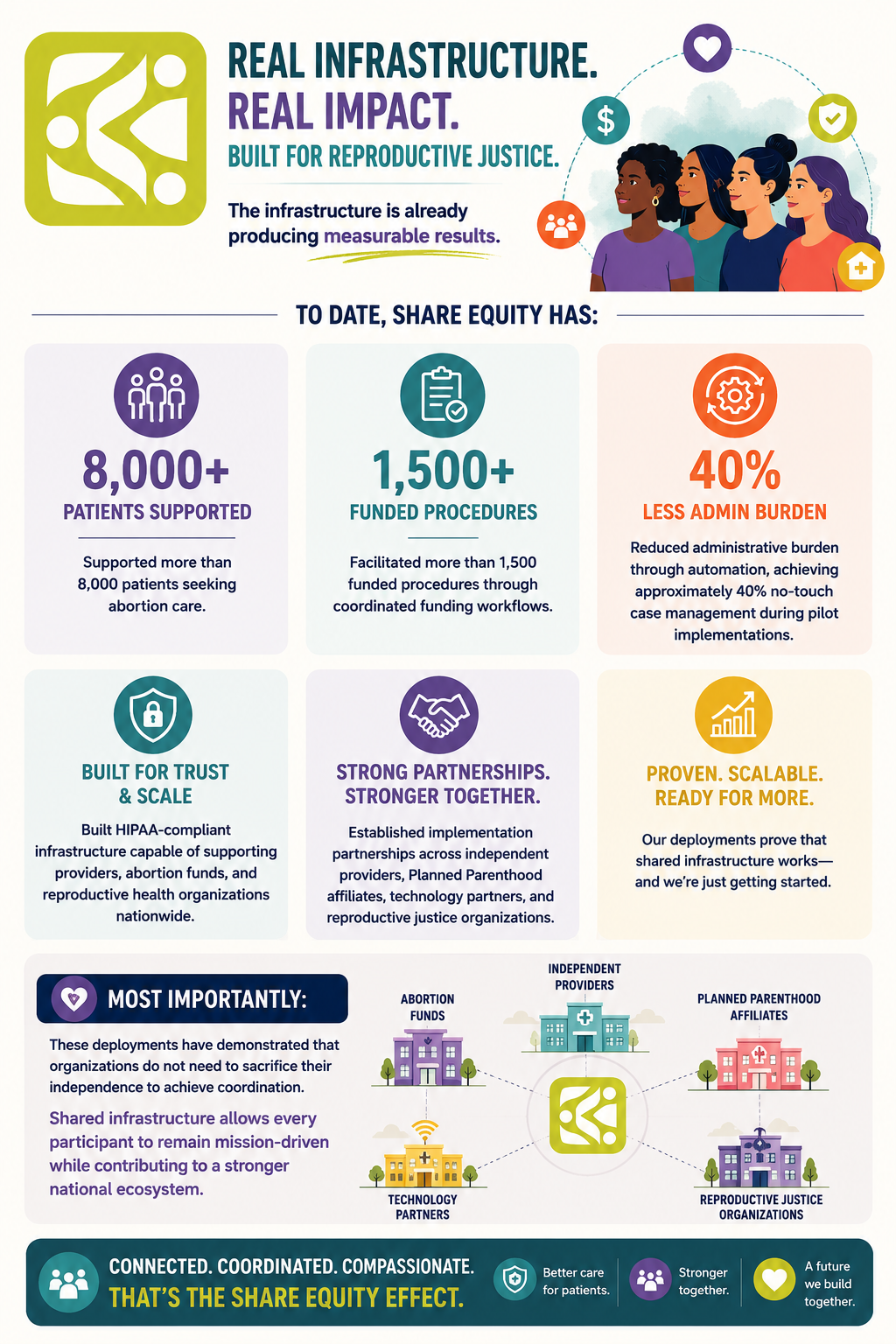
Autonomie is already coordinating real patient care and real funding.
- 661 patients supported
- $209,747 in funding facilitated
- 40% reduction in administrative coordination
What SHARE Equity and the Abortion Access Ecosystem needs is not a roadmap. It is capital.
Autonomie was engineered from the ground up to meet the security, privacy, and interoperability requirements of modern healthcare. Rather than replacing existing systems, it provides the shared infrastructure that enables providers, abortion funds, navigators, and healthcare partners to coordinate care securely within regulated clinical environments.
Epic Preferred Vendor
Recognized as an Epic Preferred Vendor, enabling interoperability with one of the nation's leading electronic health record platforms and supporting integration within existing clinical workflows.
HIPAA-Compliant Infrastructure
Designed to securely manage protected health information through enterprise-grade security, role-based access controls, comprehensive audit logging, and privacy safeguards appropriate for regulated healthcare environments.
Network-Neutral by Design
Built as shared infrastructure that connects providers, abortion funds, practical support organizations, healthcare partners, and future technologies while allowing every organization to maintain its operational independence.
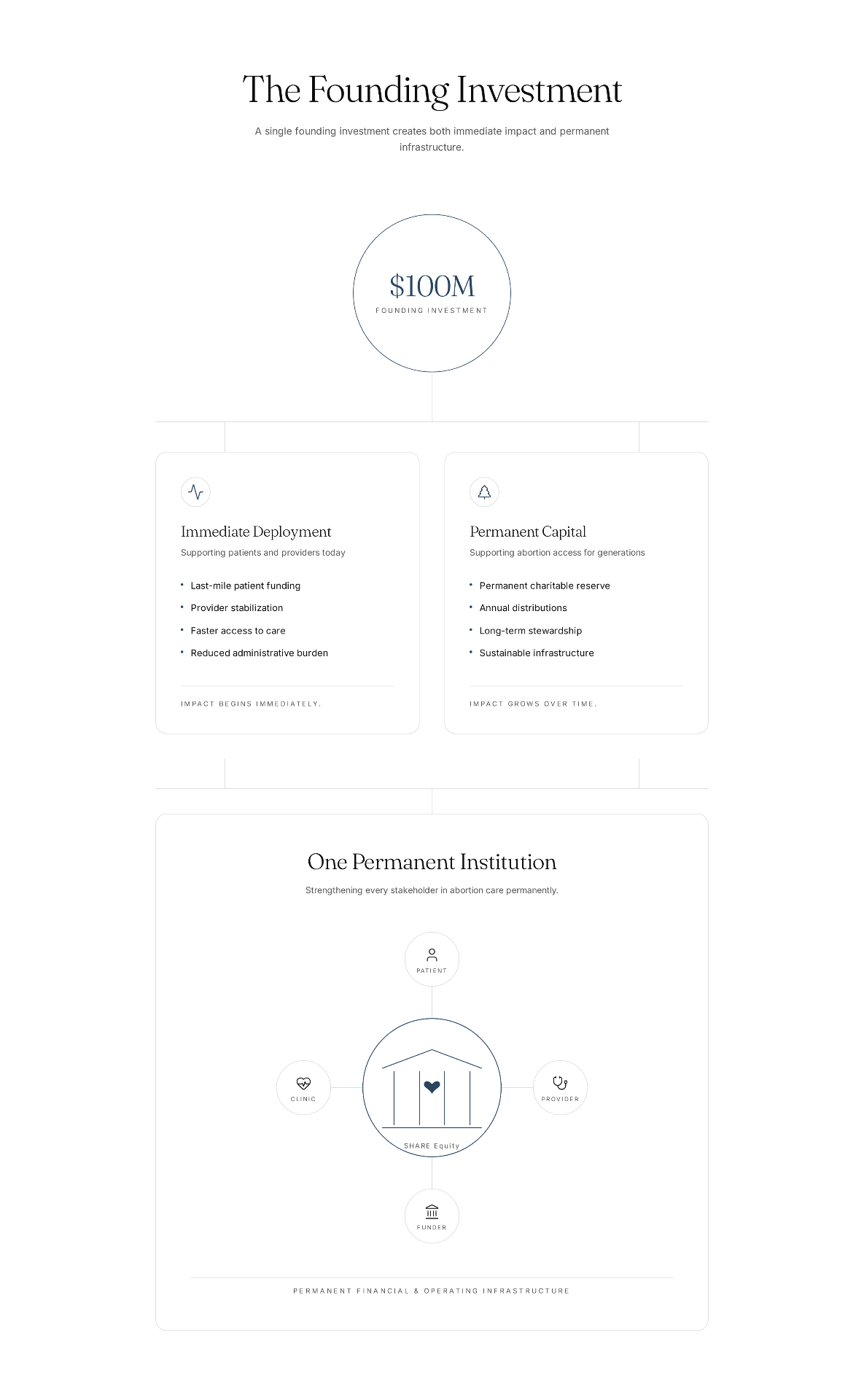
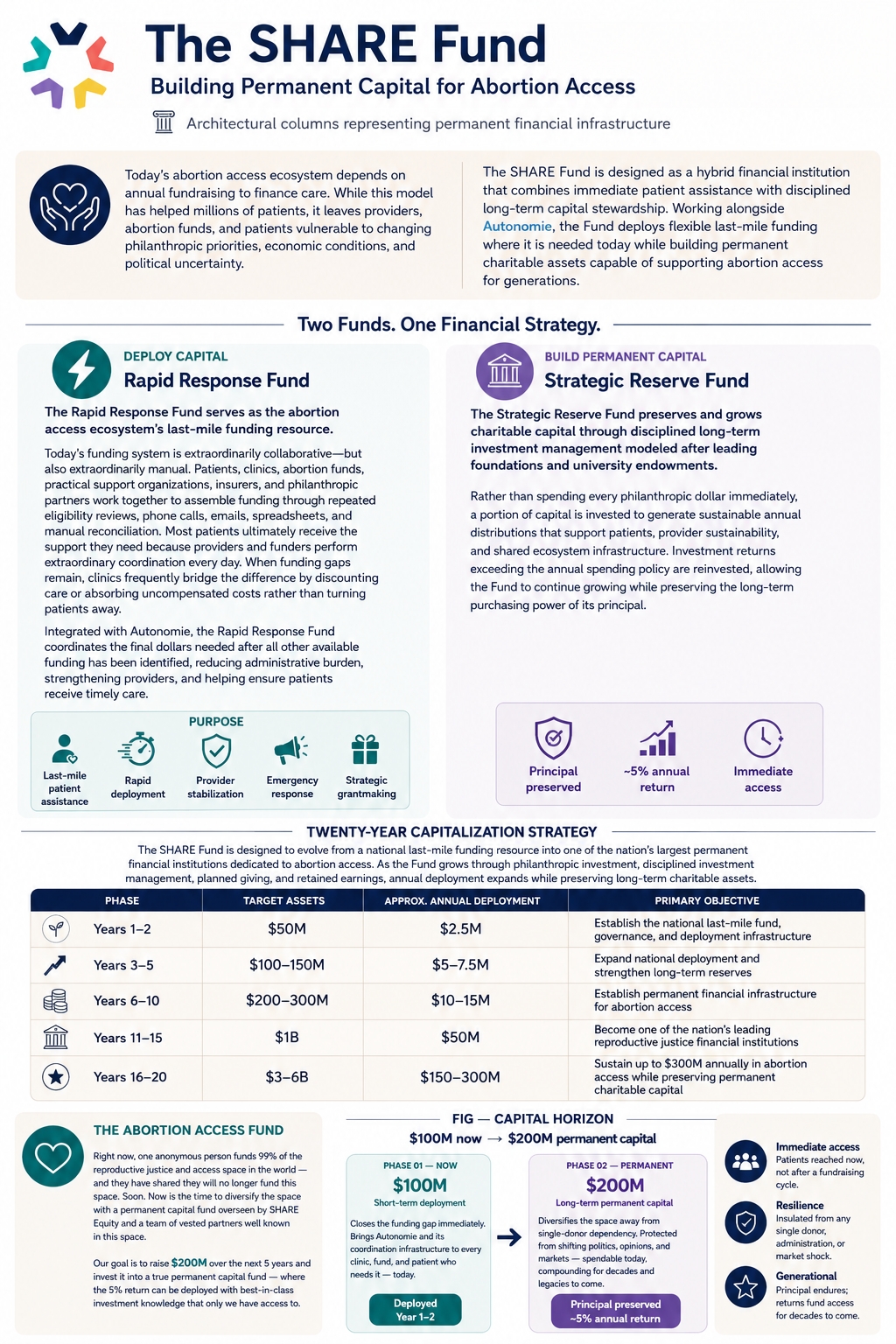
Through Autonomie, the shared operational infrastructure for abortion access, and the SHARE Fund, a permanent financial institution designed to mobilize and steward capital for patient care, SHARE Equity addresses the two structural barriers that have constrained the movement for decades: fragmented coordination and fragmented financing.
Together, these institutions create the operational, financial, and governance infrastructure required to transform abortion access from a collection of extraordinary organizations into a coordinated healthcare system.
Together,
We Will
The movement does not need another program. It needs the same infrastructure every mature healthcare system eventually builds.
Together, We Will
Build the infrastructure.
Create the shared operational platform that allows providers, abortion funds, navigators, healthcare partners, and philanthropy to coordinate care through one secure, interoperable system.
Orchestrate the ecosystem.
Connect local and national funding, independent providers, Planned Parenthood affiliates, grassroots organizations, and major philanthropy through a shared intelligence layer that enables patients, resources, and information to move where they are needed most in real time.
Capitalize the future.
Build the permanent financial institution for abortion access—ensuring that future generations inherit durable infrastructure rather than annual funding crises.
Built. Deployed. Ready to Scale.
The vision described in these pages is no longer theoretical.
Over the past several years, SHARE Equity has quietly built the infrastructure to coordinate abortion care at national scale. Working alongside independent abortion providers, Planned Parenthood affiliates, abortion funds, technology partners, and reproductive justice organizations, we've designed, tested, and deployed the systems needed for the movement's next chapter.
What began as a funding platform has evolved into something much larger.
Autonomie is shared operational infrastructure for abortion care.
Built on a secure, HIPAA-compliant, API-first architecture, it connects providers, abortion funds, navigators, and healthcare partners through a single, interoperable ecosystem—without requiring organizations to replace the systems they already use.
Autonomie enables organizations to:
- Connect patient care, funding, and navigation in one workflow
- Automate eligibility determination and funding coordination
- Use AI to streamline intake and care navigation
- Gain real-time visibility into patient journeys and provider capacity
- Integrate seamlessly with existing clinical systems through secure APIs
Rather than replacing existing technology, Autonomie strengthens it—preserving each organization's independence while making the entire ecosystem more connected, efficient, and resilient.
As the network grows, so does its value. Every participating provider, abortion fund, and partner organization strengthens the intelligence of the ecosystem while maintaining ownership of its own data, relationships, and decision-making.
Technology is not the mission.
It is the infrastructure that makes the mission possible: ensuring every patient can access timely, coordinated, fully funded, compassionate care.
Early Results
Why SHARE Equity
Many organizations provide abortion care.
Many organizations fund abortion care.
Many organizations advocate for abortion rights.
SHARE Equity occupies a different role.
We build the infrastructure that allows all of them to succeed together.
As a network-neutral organization, SHARE Equity does not compete with providers, abortion funds, or reproductive justice organizations. We strengthen them by providing the operational systems, shared intelligence, and financial infrastructure that no individual organization could reasonably build alone.
This is the role every mature healthcare system eventually develops.
Abortion access has reached the moment where it requires one as well.
Why We Are Ready
The opportunity before us is no longer technological.
The infrastructure exists.
The partnerships exist.
The implementation model exists.
The demand has never been greater.
What remains is to capitalize and deploy this infrastructure nationally before another generation inherits the same structural limitations that have constrained the movement for the past fifty years.
The Ecosystem We Strengthen
The Bridgespan Group's guide to opportunities for philanthropic support of abortion access and reproductive rights highlights many of the nation's most important organizations advancing abortion access—from providers and abortion funds to practical support organizations and reproductive justice leaders.
Many of these organizations are already partners or prospective partners of SHARE Equity.
Rather than duplicating their work, SHARE Equity builds the shared financial and operational infrastructure that helps these organizations work together more effectively. Through Autonomie and the SHARE Fund, we strengthen the systems that connect patients, providers, abortion funds, practical support organizations, and philanthropic capital—reducing administrative burden, improving coordination, and helping more resources reach patients and clinics.
Call to Action
Help build the infrastructure that makes abortion access possible. Forever.
We are convening a coalition of venture philanthropists to capitalize the infrastructure permanent capital and complete the funding infrastructure.